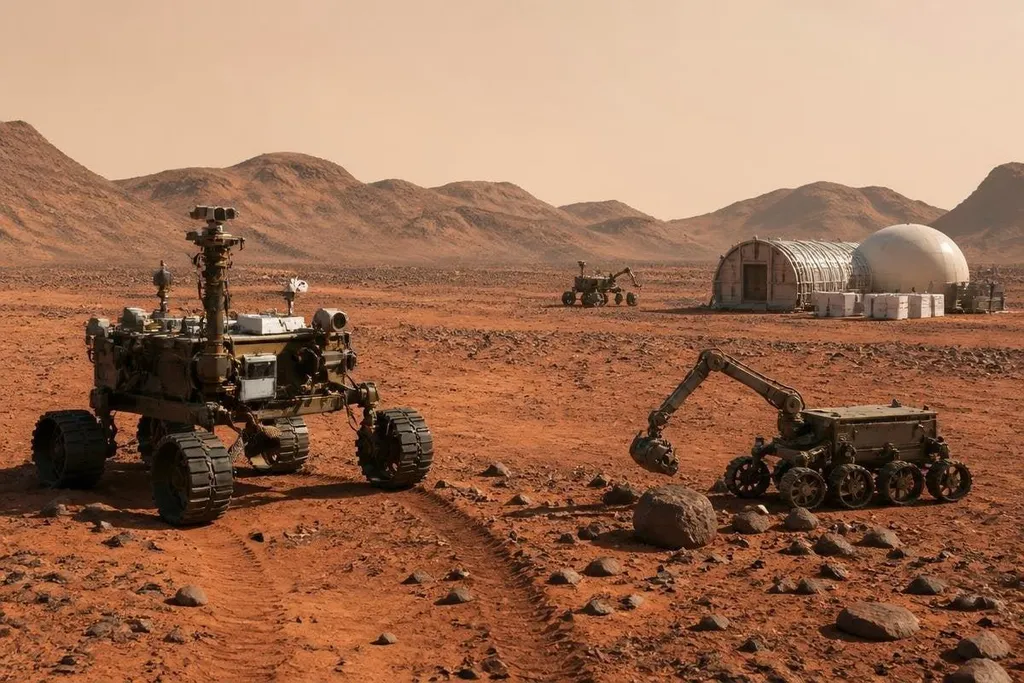
A crew cannot arrive at an empty worksite and start building on Mars. Robots would need to prepare landing areas, power systems, shelter parts, and basic supplies before a human mission could rely on them.
The hard part is not making a robot move across Mars. It is making the whole work chain run without repair crews, spare hands, or a quick trip back to Earth.
Quick read
- Robots could prepare ground, move cargo, and inspect equipment before a crew lands.
- Water, power, communications, and spare parts would decide whether the plan works.
- A robot that needs frequent help from Earth would leave too much work unfinished.
The first job is site work
A pre-arrival robot would need to turn a rough landing area into a usable worksite. That could mean clearing loose material, moving cargo away from landing paths, placing power equipment, and checking the ground before heavy hardware arrives.
Those tasks sound plain because they are plain. They also need machines that can repeat careful movements while dealing with dust, uneven ground, limited visibility, and long delays in communication.
A remote operator may send a task, but the robot would need to handle small changes without waiting for a new command each time.
The same rule applies to construction. A robot could place prepared panels, connect cables, or move sealed containers. It would need to sense whether each part had landed in the right place, then stop when a joint, cable, or load did not look correct.
Supplies matter more than speed
Human missions would need power, water, air systems, food storage, tools, and spare parts. Speed alone has limited use at a site where no technician is nearby if the machine cannot check a damaged cable.
Water would be a major planning question. Robots might be sent to search for usable ice or another local source, but finding a deposit would not finish the job. The system would still need to dig, heat, filter, store, and test the material without putting the rest of the site at risk.
Power creates the same chain of work. Solar panels need placement and cleaning. Batteries need temperature control. Cables need protection from moving equipment and dust. A failure in one part could stop several other tasks, so the site would need spare hardware and a way to find faults.
Mars plans need more than mission art. Robot24.com's robotics reporting can put named machines, field tests, and stated limits beside the work a landing site would demand. That leaves the next limit: what robots cannot solve alone.
What robots cannot solve alone
Autonomy can reduce the number of commands sent from Earth, but it does not remove the need for planning. The robot must know which jobs have priority when power runs low, a tool breaks, or a load shifts during transport.
Maintenance may be the largest gap. A human can replace a seal, clean a sensor, or change a tool after seeing the fault. The system would need a second robot, a repair station, or a design that lets it swap parts with limited help.
Software also needs a safe stop. If the robot loses its position, sees an unknown object, or detects a motor problem, it should pause and report the condition. A machine that keeps working after a bad sensor reading could damage the site it was sent to prepare.
The strongest opposing view is that robots can do the dull work before people arrive, reducing the time crews spend outside shelter. That may be true for repeated transport and inspection, but construction with unknown ground conditions still needs proof on the actual site.
A test for readiness
I'd treat a Mars preparation plan as ready only when it shows a complete work chain, not a single successful robot task. A useful review should check:
- Power: can the machines keep working through planned low-power periods?
- Repair: can a robot find, isolate, and replace a failed part?
- Cargo: can it unload and place hardware without human guidance?
- Ground work: can it confirm that a landing or building area is safe?
- Fallbacks: does the site keep operating after one robot stops?
- Proof: were the tasks run in dust, uneven ground, and long-delay control tests?
These checks connect the robot to the crew that would depend on it. A video of one clean task says little if the machine cannot store tools, report faults, or resume work after a stop.
Mars robots may prepare the first worksite, but the plan will stand or fail on recovery. Before people leave Earth, engineers need to show what happens after the first broken cable, blocked wheel, or missed placement.